Brains in the Silicon: How Neuromorphic Chips Are Redefining AI Efficiency

Introduction
Neuromorphic chips — often called “brains in silicon” — are emerging as one of the most promising technologies to solve AI’s biggest challenge: energy consumption.
While traditional GPUs and CPUs power most AI today, they are highly inefficient compared to the human brain. Neuromorphic chips mimic the brain’s neural structure, delivering massive gains in speed and efficiency.
In this guide, we explore what neuromorphic chips are, how they work, their advantages, real-world applications, and why they matter for the future of AI.
What Are Neuromorphic Chips?
Neuromorphic chips are processors designed to imitate the structure and function of biological neural networks. Instead of traditional binary computing, they use spiking neural networks (SNNs) that only activate when needed — just like neurons in the human brain.
How Neuromorphic Chips Work
Unlike GPUs that process data in batches using massive parallel computing, neuromorphic hardware processes information in a continuous, event-driven manner. This makes them extremely power-efficient, especially for AI inference at the edge.
Key Advantages of Neuromorphic Chips
Ultra-Low Power Consumption — Use 10x to 1000x less energy than GPUs for certain tasks.
Real-Time Processing — Excel at low-latency applications like robotics and autonomous systems.
Better Scalability for Edge AI — Ideal for devices with limited battery life.
Higher Efficiency for Sparse Data — Perfect for real-world sensory data.
Reduced Heat Generation — Enables deployment in compact or harsh environments.
Major Players and Current Technology (2026)
Intel Loihi 2 — One of the most advanced research chips.
IBM TrueNorth — Pioneer in neuromorphic computing.
BrainChip Akida — Commercial edge AI chip already in production.
SpiNNaker2 — University of Manchester’s large-scale neuromorphic system.
Qualcomm & Samsung — Actively developing neuromorphic solutions for mobile and IoT.
Real-World Applications Transforming Industries
Autonomous vehicles and drones
Smart sensors and IoT devices
Medical wearables and implantable devices
Industrial predictive maintenance
Always-on voice and vision processing
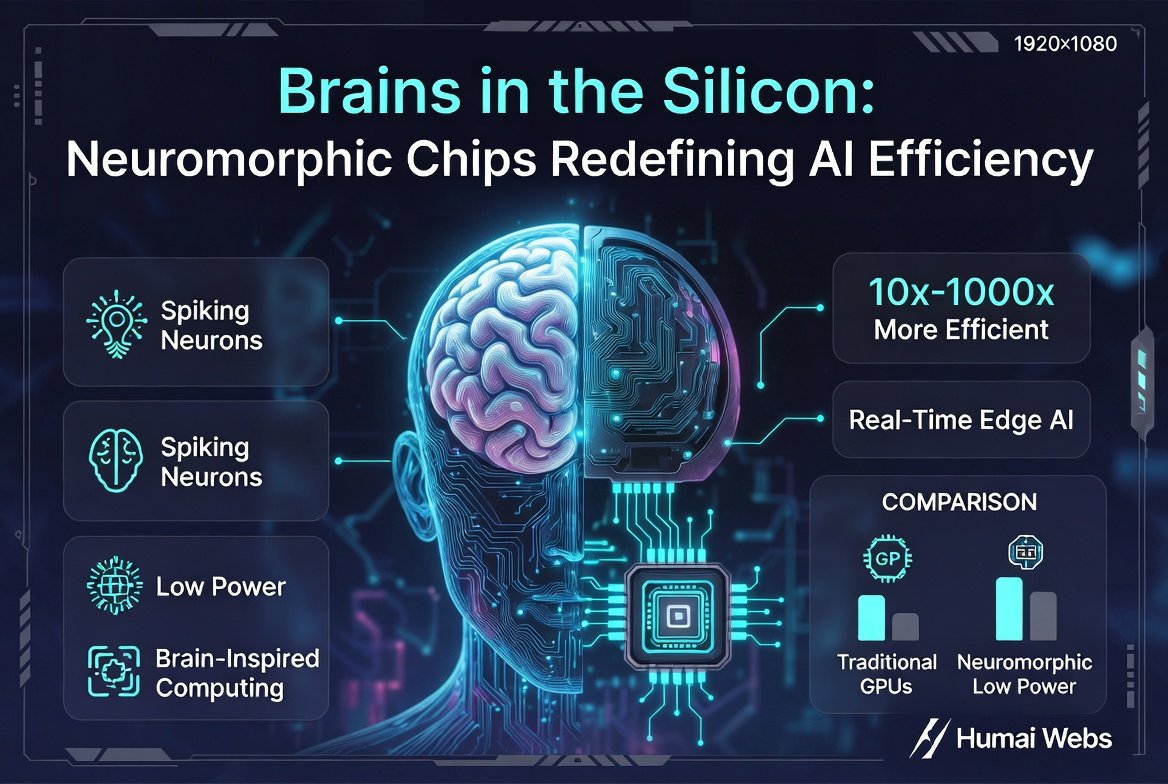
Neuromorphic Chips vs Traditional GPUs
While GPUs dominate training large models, neuromorphic chips are winning at efficient inference, especially on battery-powered or edge devices.
Challenges Facing Neuromorphic Computing
Programming complexity, limited software ecosystem, and integration with existing AI frameworks remain key hurdles, though progress is rapid.
FAQ Section
What are neuromorphic chips?
Processors designed to mimic the human brain’s neural networks for highly efficient AI computation.
How much more efficient are neuromorphic chips?
They can be 10 to 1000 times more energy-efficient than traditional GPUs for specific AI workloads.
Will neuromorphic chips replace GPUs?
Not entirely. They are expected to complement GPUs — excelling at edge inference while GPUs continue to dominate large-scale training.
Which industries will benefit most from neuromorphic chips?
Robotics, autonomous systems, IoT, healthcare, and consumer electronics with battery constraints.
Are neuromorphic chips available commercially in 2026?
Yes. Several chips like BrainChip Akida and Intel Loihi 2 are commercially available or in advanced deployment.
11. Conclusion with CTA
Neuromorphic chips represent a fundamental shift in how we build AI systems — moving from brute-force computing to brain-like efficiency. As energy costs and sustainability concerns grow, these “brains in silicon” are set to play a crucial role in the next generation of intelligent devices.
The future of AI will not only be more powerful but also dramatically more efficient.
Want to explore how neuromorphic chips and advanced AI hardware can benefit your organisation?
The team at Humai Webs helps UK businesses adopt cutting-edge AI technologies and build efficient, future-ready intelligent systems.
Contact us today for a consultation on next-generation AI infrastructure.
Visit: humai Webs