Connecting the Dots: Boosting Enterprise AI Accuracy with Graph Databases and GraphRAG
Introduction
GraphRAG is one of the most powerful advancements in Enterprise AI in 2026. By combining graph databases with Retrieval-Augmented Generation (RAG), organisations are overcoming the biggest limitations of traditional AI — hallucinations, lack of context, and poor reasoning.
This approach allows AI systems to truly “connect the dots” across vast amounts of enterprise data.
In this guide, we explain what GraphRAG is, how it works, its major benefits, and how UK enterprises are successfully implementing it.
What is GraphRAG?
GraphRAG (Graph Retrieval-Augmented Generation) enhances standard RAG by using knowledge graphs instead of simple vector search. It structures data as interconnected nodes and relationships, enabling AI to understand context and complex connections much better.
Why Traditional RAG Falls Short in Enterprises
Standard vector-based RAG often struggles with:
Complex relationships between data points
Multi-hop reasoning
Enterprise-scale structured and unstructured data
Maintaining accuracy in domain-specific knowledge
How Graph Databases + GraphRAG Solve These Problems
1. Superior Context Understanding
Graph databases store relationships between entities, allowing AI to traverse connections naturally.
2. Better Multi-Hop Reasoning
AI can follow chains of relationships (e.g., Customer → Purchase → Product → Supplier) for deeper insights.
3. Reduced Hallucinations
Grounding responses in structured knowledge graphs leads to significantly higher accuracy.
4. Real-Time Knowledge Updates
Graphs can be updated dynamically as new data arrives.
5. Explainable AI Outputs
You can trace exactly how the AI reached its conclusion through the graph paths.
Real-World Benefits of GraphRAG for Enterprises
Finance: Better fraud detection and risk analysis
Healthcare: Improved patient journey mapping and diagnosis support
Supply Chain: Enhanced visibility and predictive logistics
Legal & Compliance: Faster document analysis and obligation tracking
Customer Service: More intelligent and context-aware chatbots
GraphRAG vs Traditional RAG
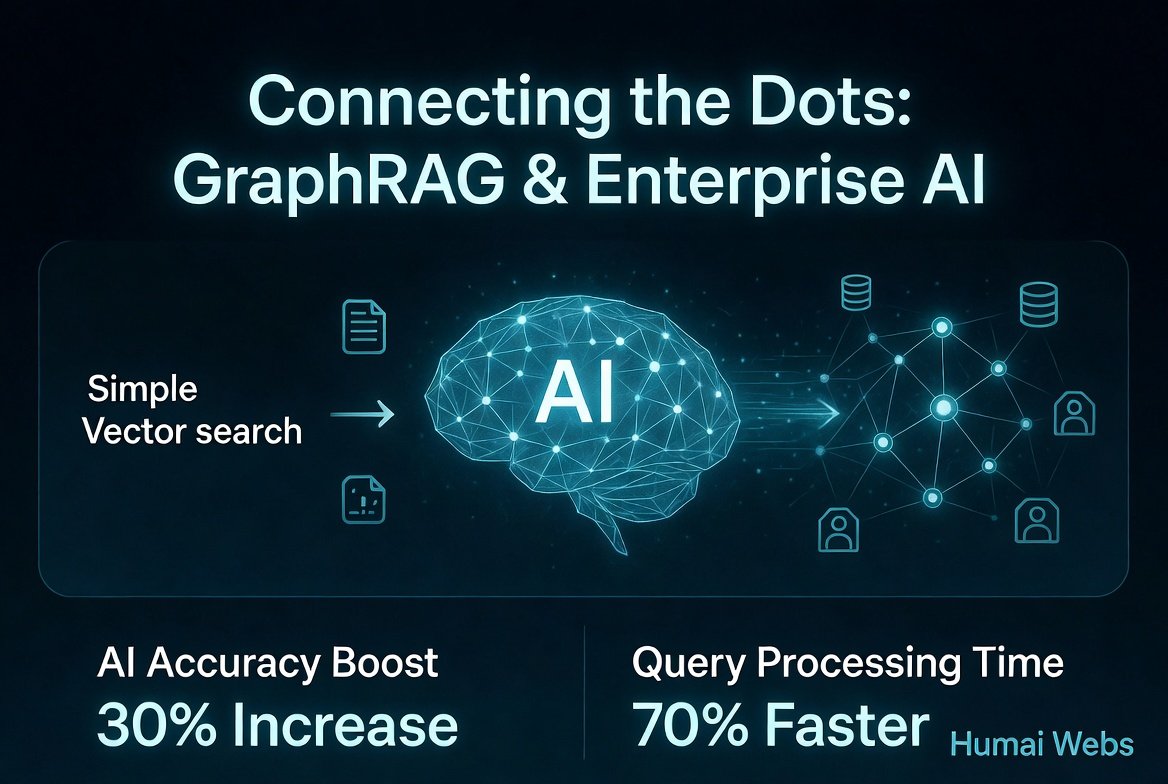
While vector RAG retrieves similar chunks of text, GraphRAG retrieves relevant entities and their relationships, delivering far superior reasoning capabilities.
H3: Best Graph Databases for GraphRAG in 2026
Neo4j (most popular)
Amazon Neptune
Microsoft Azure Cosmos DB Graph
TigerGraph
Memgraph
What is GraphRAG?
GraphRAG combines knowledge graphs with Retrieval-Augmented Generation to improve AI accuracy and reasoning by understanding relationships between data points.
How much does GraphRAG improve AI accuracy?
Many enterprises report 30–70% improvement in response accuracy and relevance compared to traditional RAG.
Do I need a graph database for GraphRAG?
Yes. Graph databases are essential for efficiently storing and querying the complex relationships that power GraphRAG.
Is GraphRAG suitable for small businesses?
It’s more suitable for mid-to-large enterprises with complex data relationships, though smaller companies can start with simpler implementations.
What are the main challenges of implementing GraphRAG?
Data modelling complexity, integration effort, and the need for graph expertise are the biggest hurdles.
11. Conclusion with CTA
GraphRAG represents a major leap forward in Enterprise AI — moving from simple text retrieval to true knowledge understanding. By combining graph databases with retrieval-augmented generation, organisations can build AI systems that are significantly more accurate, reliable, and intelligent.
The ability to “connect the dots” across enterprise data is becoming a key competitive advantage.
Ready to boost your Enterprise AI accuracy with GraphRAG?
The team at Humai Webs helps UK enterprises design and implement advanced AI solutions, including GraphRAG and knowledge graph architectures.
Contact us today for a free consultation and discover how GraphRAG can transform your AI capabilities.
Visit: humai Webs