Fake Data, Real Insights: Why Synthetic Data Is the Solution to AI’s Privacy Bottleneck
Introduction
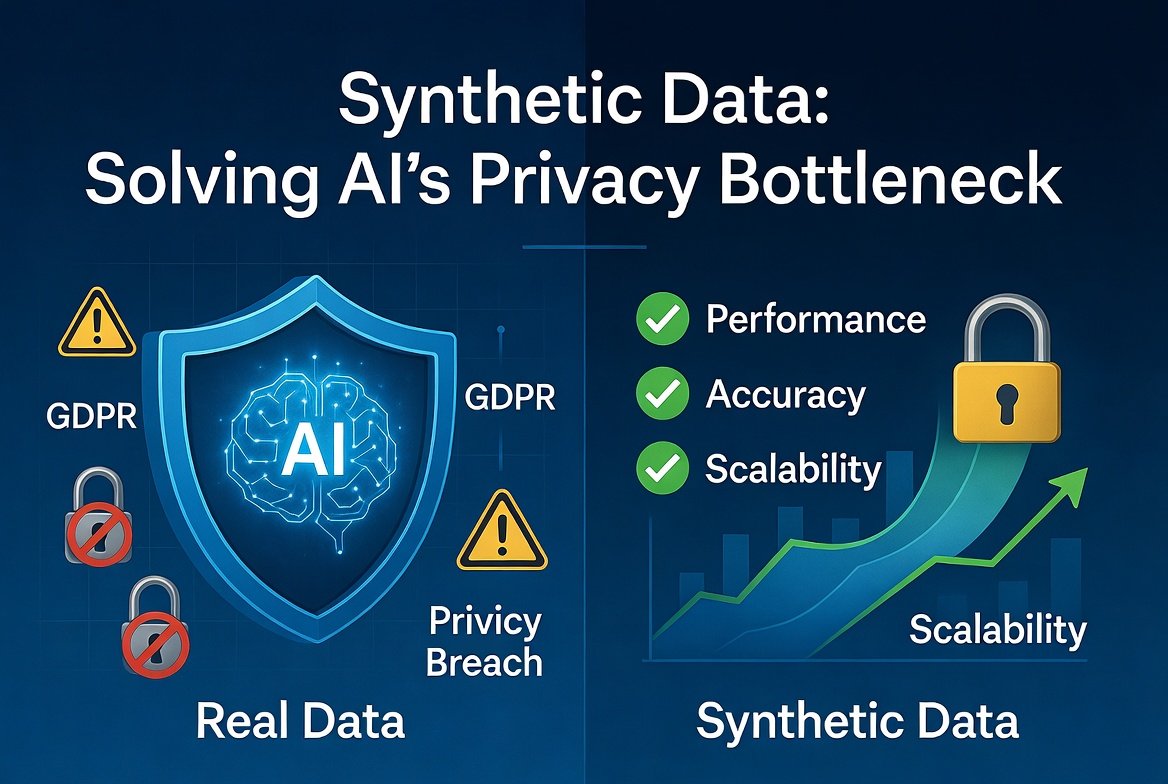
AI needs massive amounts of high-quality data to perform well. But real-world data is often locked behind strict privacy laws like GDPR and faces growing security risks.
Synthetic data offers the perfect solution. It is artificially generated data that mirrors the statistical properties of real data without exposing any personal information.
In this guide, you’ll learn how synthetic data helps businesses overcome the privacy bottleneck, train better AI models, and maintain full compliance — all while unlocking real business insights.
What Is Synthetic Data and How Does It Work?
Synthetic data is created using advanced algorithms, statistical models, and AI techniques such as Generative Adversarial Networks (GANs), Variational Autoencoders (VAEs), and Large Language Models.
It replicates the patterns, relationships, and distributions found in original datasets while containing zero real personal information. This makes it safe to share and use freely.
Modern synthetic data platforms can now generate highly realistic datasets for images, text, tabular data, and even time-series information.
The Growing Privacy Bottleneck in AI Development
Organizations face serious challenges when building AI systems:
Strict data protection regulations (GDPR, CCPA, UK Data Protection Act)
Increasing risk of data breaches
Difficulty obtaining consent for training data
Limited access to diverse, high-quality datasets
Slow approval processes for real data usage
These constraints create a major bottleneck that slows innovation and increases costs. Synthetic data directly addresses all these pain points.
Why Synthetic Data Is the Best Solution for AI Privacy
Synthetic data provides multiple powerful advantages:
Complete Privacy Protection: No real individuals can be identified or re-identified.
Unlimited Volume: Generate as much data as needed without additional collection costs.
Bias Mitigation: Carefully engineered synthetic datasets can reduce bias present in real data.
Rare Event Simulation: Easily create examples of uncommon scenarios that are hard to find in real datasets.
Faster Development: Remove lengthy approval cycles and legal reviews.
Leading companies like Google, Meta, and financial institutions are already using synthetic data at scale with excellent results.
Key Benefits of Synthetic Data for AI Projects
Here are the main reasons forward-thinking companies are adopting synthetic data:
Regulatory Compliance — Easily meet GDPR, HIPAA, and other standards.
Enhanced Security — Reduce breach impact since no real sensitive data is used.
Cost Efficiency — Lower expenses related to data collection, storage, and anonymization.
Improved Model Performance — Test edge cases and scale training data dramatically.
Better Collaboration — Safely share datasets with partners and researchers.
Real-World Applications of Synthetic Data
Healthcare: Generate realistic patient records and medical images for training diagnostic AI without compromising patient privacy.
Finance: Create synthetic transaction data to detect fraud patterns while staying fully compliant.
Autonomous Vehicles: Simulate millions of rare driving scenarios that would be dangerous or expensive to capture in real life.
Retail & Marketing: Build customer behavior models without using actual personal data.
Natural Language Processing: Train models on synthetic conversations that preserve linguistic patterns.
How to Generate and Implement Synthetic Data Effectively
Follow these steps for successful adoption:
Assess your current data needs and privacy risks
Choose the right synthetic data generation tools (e.g., Mostly AI, Gretel, Synthpop, or open-source solutions)
Validate synthetic data quality using statistical similarity metrics
Start with a hybrid approach — combine synthetic data with carefully anonymized real data
Continuously test and monitor model performance
Document your synthetic data processes for compliance audits
Challenges and Best Practices When Using Synthetic Data
While powerful, synthetic data has limitations. It may not perfectly capture all real-world complexities. Address this by:
Using high-fidelity generation models
Validating against real-world outcomes
Combining multiple generation techniques
Maintaining human oversight in critical applications
Types of Synthetic Data You Should Know
Fully synthetic data
Partially synthetic data
Hybrid synthetic data
Synthetic text and image data
How Synthetic Data Compares to Traditional Anonymization
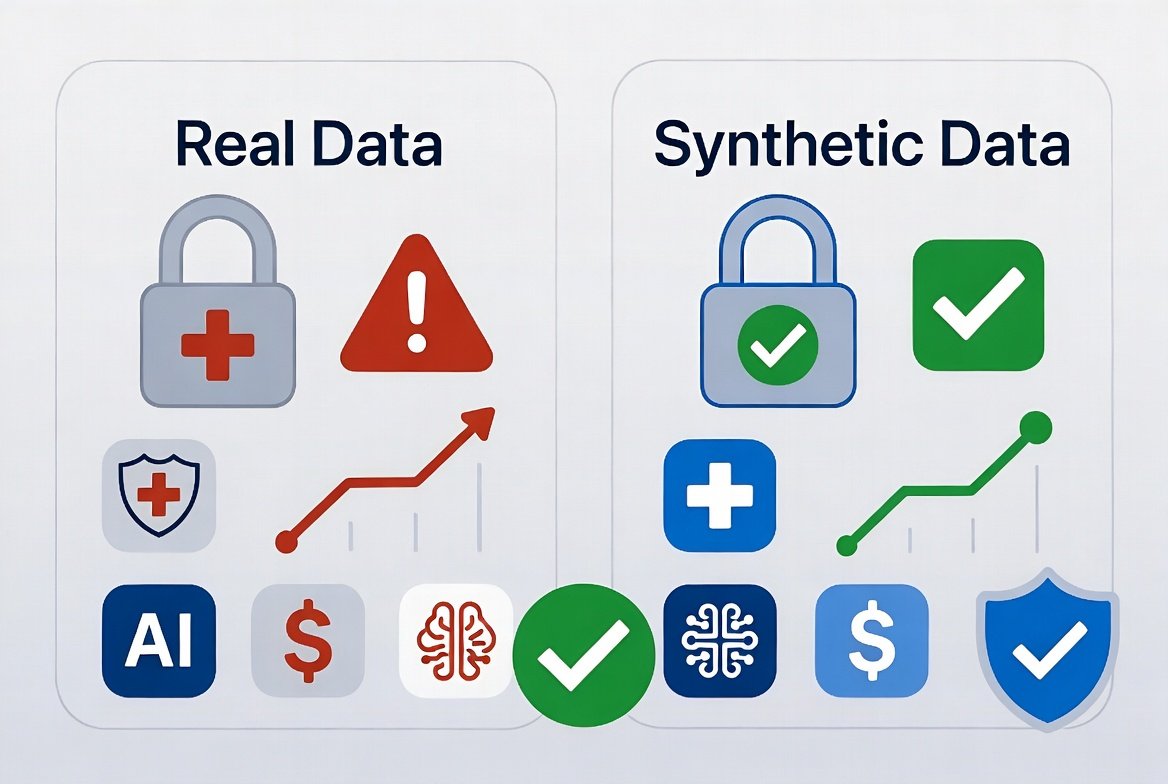
Traditional methods like masking or pseudonymization often fail against re-identification attacks. Synthetic data provides much stronger privacy guarantees.
What is synthetic data in AI?
Synthetic data is artificially generated data that statistically resembles real data but contains no actual personal information from real people.
Is synthetic data compliant with GDPR?
Yes. When properly generated, synthetic data is generally considered privacy-safe and helps organizations meet GDPR requirements more easily.
Can AI models trained on synthetic data perform as well as those trained on real data?
In most cases, yes — especially when high-quality synthetic data is used. Many organizations report comparable or even better performance due to larger volumes and reduced bias.
What industries benefit most from synthetic data?
Healthcare, finance, insurance, autonomous vehicles, and marketing benefit the most from synthetic data due to heavy regulation and privacy concerns.
How do I start using synthetic data in my business?
Begin with a pilot project on one dataset. Many platforms offer free trials and easy-to-use interfaces for generating your first synthetic datasets quickly.
Synthetic data is no longer a futuristic concept — it is a practical, powerful solution to AI’s biggest current limitation: the privacy bottleneck.
By using fake data to generate real insights, your organization can innovate faster, reduce risk, and build better AI systems responsibly.
Ready to unlock the full potential of AI without privacy headaches?
Contact Humai Webs today. Our AI experts help UK businesses implement synthetic data solutions tailored to their industry and compliance needs.
Visit humaiwebs or get in touch for a free consultation.