Incident Response Plans: What to Do When Your Web App is Breached

Introduction
A web app breach can happen in seconds — but how you respond determines whether it becomes a minor incident or a major disaster.
An effective incident response plan is your organisation’s safety net. It provides clear, step-by-step actions to detect, contain, and recover from cyber attacks quickly while minimising damage, downtime, and legal risks.
In this guide, you’ll learn how to build and activate a strong incident response plan tailored for modern web applications.
Why Every Web App Needs a Strong Incident Response Plan
Breaches are no longer a matter of “if” but “when.” Without a prepared incident response plan, teams waste precious time during chaos, leading to bigger losses, regulatory fines, and reputational damage.
A well-designed plan ensures fast, coordinated action and compliance with UK GDPR and other regulations.
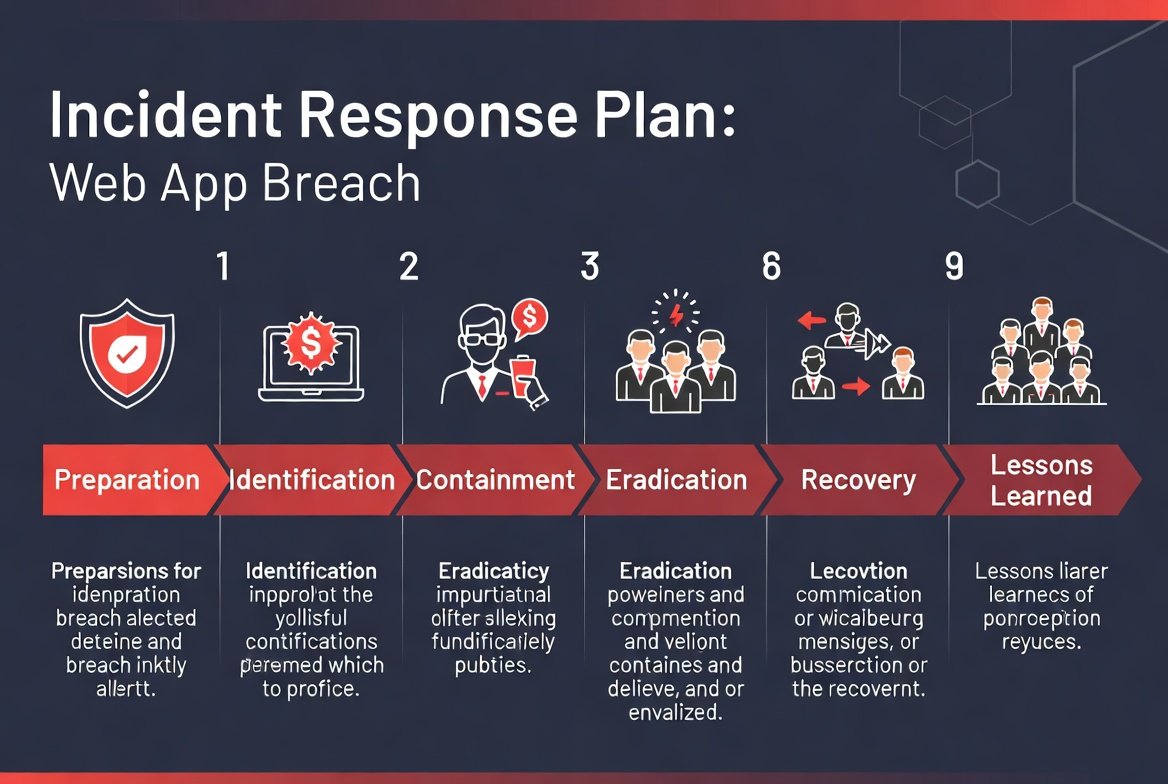
The 6 Phases of an Effective Incident Response Plan
Follow the industry-standard NIST or SANS model:
Preparation — Build your team, tools, and documentation
Identification — Detect and confirm the breach
Containment — Stop the attack from spreading
Eradication — Remove the threat completely
Recovery — Restore systems safely
Lessons Learned — Review and improve
Step-by-Step: What to Do When Your Web App Is Breached
Immediate Actions (First Hour):
Activate your incident response team
Isolate affected systems
Preserve evidence (logs, memory dumps)
Notify key stakeholders internally
Short-Term Actions (First 24–48 Hours):
Investigate root cause
Patch vulnerabilities
Communicate with customers if required
Engage legal and PR teams
Long-Term Actions:
Conduct forensic analysis
Update security policies
Test and improve your incident response plan
Building Your Web App Incident Response Team
Incident Commander
Technical Leads (DevOps, Security)
Legal & Compliance
Communications
Executive Sponsor
Define roles, responsibilities, and 24/7 contact information clearly in your plan.
Essential Tools for Web App Incident Response
SIEM systems (e.g., ELK Stack, Splunk)
Endpoint Detection & Response (EDR)
Logging & Monitoring tools
Forensic toolkits
Backup & Disaster Recovery solutions
Incident management platforms (PagerDuty, TheHive)
Common Web App Breach Scenarios and How to Handle Them
SQL Injection / API Attacks
Credential Stuffing
Ransomware on Web Servers
Supply Chain Attacks (third-party plugins)
DDoS combined with data exfiltration
Legal and Regulatory Requirements in the UK
Understand your obligations under GDPR, including 72-hour breach notification rules.
How to Test Your Incident Response Plan
Regular tabletop exercises and simulated breaches are critical for readiness.
FAQ Section
What is an incident response plan?
An incident response plan is a documented, structured approach that outlines how an organisation should detect, respond to, and recover from cybersecurity incidents.
How often should I update my incident response plan?
Review and update it at least twice a year, or after any major system change or security incident.
Do small businesses need a formal incident response plan?
Yes. Even small web apps handling user data must have a basic plan to limit damage and meet legal requirements.
What is the biggest mistake companies make during a breach?
Delaying containment and poor internal/external communication.
Should I pay a ransomware demand?
Generally no. Experts and authorities advise against it as it funds criminals and doesn’t guarantee data recovery.
Conclusion with CTA
A strong incident response plan turns a potential catastrophe into a manageable event. Being prepared can save your business significant time, money, and reputation when a web app breach occurs.
Don’t wait until an attack happens.
Ready to strengthen your web application security and build a robust incident response plan?
Contact the cybersecurity experts at Humai Webs today. We help UK businesses create, test, and maintain effective incident response strategies.
Visit humaiwebs or get in touch for a free security consultation.